I found this old, but still relevent article on bnet.com
Anyone who’s ever heard a Jimi Hendrix solo knows that guitars can produce fantastic sounds, and anyone who’s ever ogled the curves of a Fender Stratocaster will tell you they’re mighty stylish as well. But the instrument’s appeal goes well beyond its visual or sonic charm, its practicality or even its ties to musical history–it can also be a highly prized collectible. Certain vintage models are often regarded as investments, much like antique chairs or Impressionist paintings. Perhaps this is why so many people who start out with a youthful passion for playing end up happy victims of what Walter Becker of the rock band Steely Dan once drolly referred to as “GAS: Guitar Acquisition Syndrome.”
Look among the ranks of those who’ve caught this particular bug, and you’ll find a surprising number of chief executives, most of whom aren’t professional musicians but all of whom grew up with rock music and are now helping to drive the vintage market upwards. Take Microsoft co-founder Paul Allen, for example; his collection includes the white 1968 Stratocaster that Jimi Hendrix played at Woodstock in August 1969. Bought from an Italian disk jockey for $1.3 million, that guitar is now the centerpiece of the Allen-funded Experience Music Project, a Seattle rock ‘n’ roll museum and historical foundation that opened in 2000.
Allen may be America’s best-known executive guitar collector, but there are lots more. Frank De Fina, president of Panasonic Systems Solutions Company of America, conservatively estimates that his collection is “in the dozens.” Its highlights include a 1939 Martin D-18 acoustic and three electric models lusted after by collectors worldwide: a 1953 Fender Esquire, a 1956 Fender Stratocaster and a 1959 Gibson Les Paul. With such a large number of treasures on hand, storage became an issue. So a few years back, De Fina bought a bank vault to house his collection. “Bank vaults are more readily available than many kinds of vintage guitars,” he quips, “and they’re a lot cheaper, too.”
Tom Simons, president and creative director of Partners & Simons, a Boston marketing firm, doesn’t have as extensive a collection as De Fina, and regards himself as “a guitar accumulator” rather than a collector. Still, the dozen instruments that he’s accumulated would probably strike most people as extravagant. One of them, a Danelectro Bellzouki electric 12-string from the mid-’60s, is described by its owner as “not playable but fun to look at.” Comments like this, by the way, are a sure sign that GAS has taken hold.
Henry Juszkiewicz’s early interest in playing and collecting guitars was so strong that he ended up buying a guitar company; since 1986, he’s been the CEO of Gibson, makers of the legendary Les Paul, among many others. His collection now numbers “around 40,” mainly Gibson prototypes, including two models designed by country great Chet Atkins. Juszkiewicz confesses that he owns guitars besides Gibsons–“I can’t be a one-brand guy,” he admits–but in deference to his position, he won’t reveal what they are.
Diamonds in the Rough
Why has guitar collecting become such a popular pursuit for these and so many other chief executives? Most just love the instrument, for the way it looks, sounds and feels. Many also love it for what it represents: their youth. “There’s a little bit of the outlaw in the electric guitar,” marketer Simons says. “What’s more, CEOs are the business world’s version of rock stars, and a climate-controlled closet humidor full of vintage instruments is a link back to a time when they were able to practice the occasional bad behaviors without repercussions. Those guitars are reminders of when the good times really rolled.”
Of course, there are other, perhaps more shrewd, reasons. “Look at a guitar that sells for $12,000,” says Gibson’s Juszkiewicz, “then look at a diamond that sells for the same amount of money. It’s this little stone. There’s no craftsmanship, there’s no history, and it does nothing. There are a lot of diamonds being sold out there, and yet I would posit that the guitar is of more legitimate value. The reality is that in our marketplace, the investment quality of instruments is pretty phenomenal.”
He’s not joking. In the last few years, the prices of vintage guitars have skyrocketed. The most extreme case is that of the Gibson Cherry Sunburst Les Paul. Approximately 1,700 of these guitars were made between 1958 and 1960 before the line was discontinued due to lack of popularity. Their original list price was under $300; as recently as five years ago, you could find one for $45,000. Today, they’re selling for $250,000. And Stan Jay, president of leading vintage guitar dealer Mandolin Brothers in Staten Island, N.Y., wagers that a mint-condition “Burst” could fetch $300,000 before this year is over.
Other high-ticket items are Martin acoustic guitars made before World War II and so-called “pre-CBS” Fender electric guitars, made before CBS bought the company in 1965. “The rate of appreciation for those models in the last year has been the fastest I’ve ever seen.” says George Gruhn, owner of Gruhn Guitars in Nashville, author of Gruhn’s Guide to Vintage Guitars, and generally acknowledged as one of the world’s foremost guitar authorities. “Some of them have jumped as much as 75 percent.” And though Gruhn is as shocked as anyone by these price hikes, he doubts that the bubble will burst in any lasting way: “I haven’t seen any guitars drop in value and never get back, and I’ve been doing this for 42 years.”
read the rest of the artice here

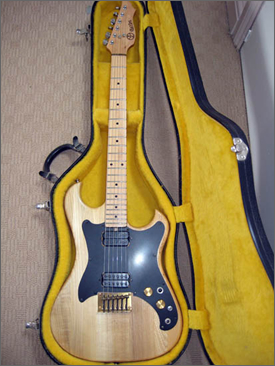 I found this guitar for sale today while I was cruising around some guitar sites.
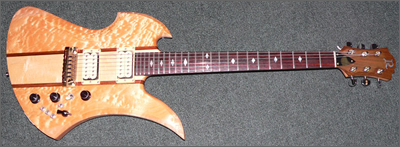 The original Mockingbirds had neck-through body design, as all BC Riches then had and many do in the current range.
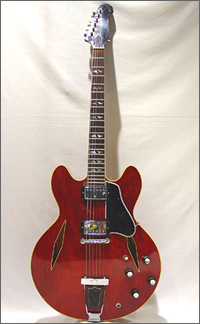 The Standard is based on the classic ES335 shape, but with a trapeze tailpiece (as seen on early Gibson Les Pauls) and diamond-shaped soundholes. The guitar also differed to an ES335 in that it had a Gibson Firebird neck set into the body.
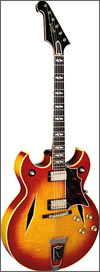 The Lopez models were discontinued in 1971 and are collectible and highly prized today, although not particularly expensive at this point in time.


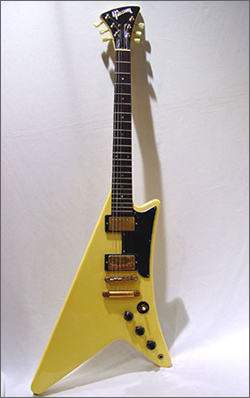 The Gibson Moderne is one of Gibson’s most infamous instruments, and due to its limited production and the story surrounding it, it has acquired semi-mythical status.
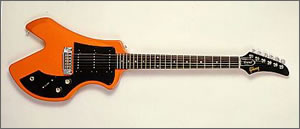 The Corvus (Latin-speakers may know this is a Latin word meaning crow, which is maybe what Gibson were trying to emulate with this shockingly unconventional design) was a complete failure for the company and was withdrawn, having sold barely any units, in 1984.
 The Official Vintage Guitar Magazine Price Guide 2009 (Official Vintage Guitar Magazine Price Guide)
 Gruhn’s Guide to Vintage Guitars: An Identification Guide for American Fretted Instruments
 Warmans Vintage Guitar Field Guide (Warman’s Field Guides)
 Blue Book of Electric Guitars
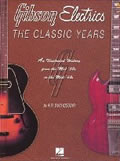 Gibson Electrics: The Classic Years
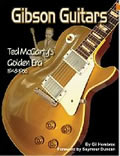 Ted McCarty’s Golden Era 1948-1966
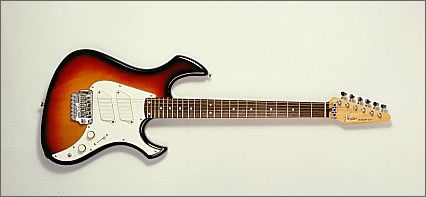 The unusual body and headstock shapes have been rumored to have originated in the shape of the scrap wood leftover from making Japanese Stratocasters. The body is small with a deep double cutaway. The tuning machines are found on the upper edge of the triangular headstock. The fretboard is two octaves and features a locking nut and jumbo frets. The bridge is a floating System I tremolo. Both bass and guitar are built to the highest level of quality and detailing. For example, the controls have inset rubber grips, the tuning heads have fully enclosed gears and the jack sockets are an enclosed, not ‘skeleton’, type, in contrast to many other Fender products with more ‘economy’ hardware.
 The Bond Electraglide was a very unusual, little-known guitar made in Scotland by Andrew Bond in 1984-5.
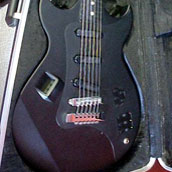 The guitar was launched at the 1984 NAMM show in America. Apart from the various gimmicks featured on the guitar, including the required use of an external power supply, it played normally and sounded normal, with three single-coil pickups and a normal body shape.
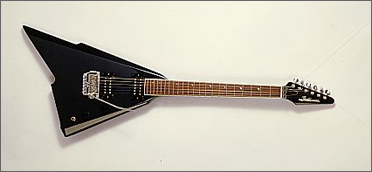 The Katana and Performer were exclusively built in Fender’s then – new Japanese plant, built in response to much cheaper and nearly as good Japanese copies of Fender’s models.
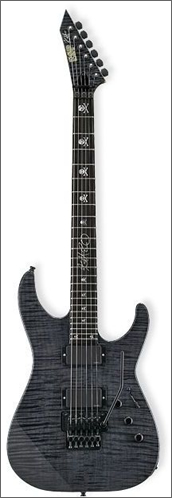 You can read more about the superstrat in our
 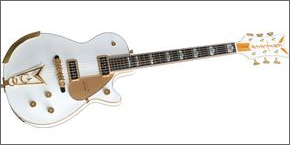 The 6136 (also known as the White Falcon or “the Cadillac of guitarsâ€) is a well-known Gretsch guitar, a big-bodied semi-acoustic finished in gleaming white, with all manner of elaborate trimmings like an armrest on the bass side of the body, gold binding and a huge tone that saw it used by Brian Setzer, Billy Duffy of The Cult and Stephen Stills.